
Behavioral intelligence systems
Human-Centered Systems: Engineering Culture as a Primary Economic Layer
An article based on the CVEST white paper by Houston Khanyile on why culture should be treated not as market residue, but as economic infrastructure.

Abstract
Human-Centered Systems argues that culture is one of the deepest coordination layers in human life, yet economies have mostly treated it as a side effect of products rather than as a primary output in its own right. The paper proposes a stack through which culture can be designed, distributed, measured, and rewarded as an economic layer.
The missing layer in modern markets
Modern economies are highly developed in the monetization of goods, services, labor, access, information, and attention. What they still treat indirectly is culture: the layer through which people interpret identity, belonging, symbolism, legitimacy, aspiration, and shared meaning. The white paper’s central claim is that this omission is no longer tenable.
Products often derive their lasting power not simply from function, price, or reach, but from the cultural systems that form around them. Human-Centered Systems reframes that reality. Instead of treating culture as an emergent byproduct, it treats culture as the thing being intentionally produced and administered.
This is the shift from selling cultural carriers to building cultural infrastructure. In that model, the product no longer sits at the center by default. The deeper economic object becomes the system of meaning, participation, and reinforcement that the product enables.
From values to culture
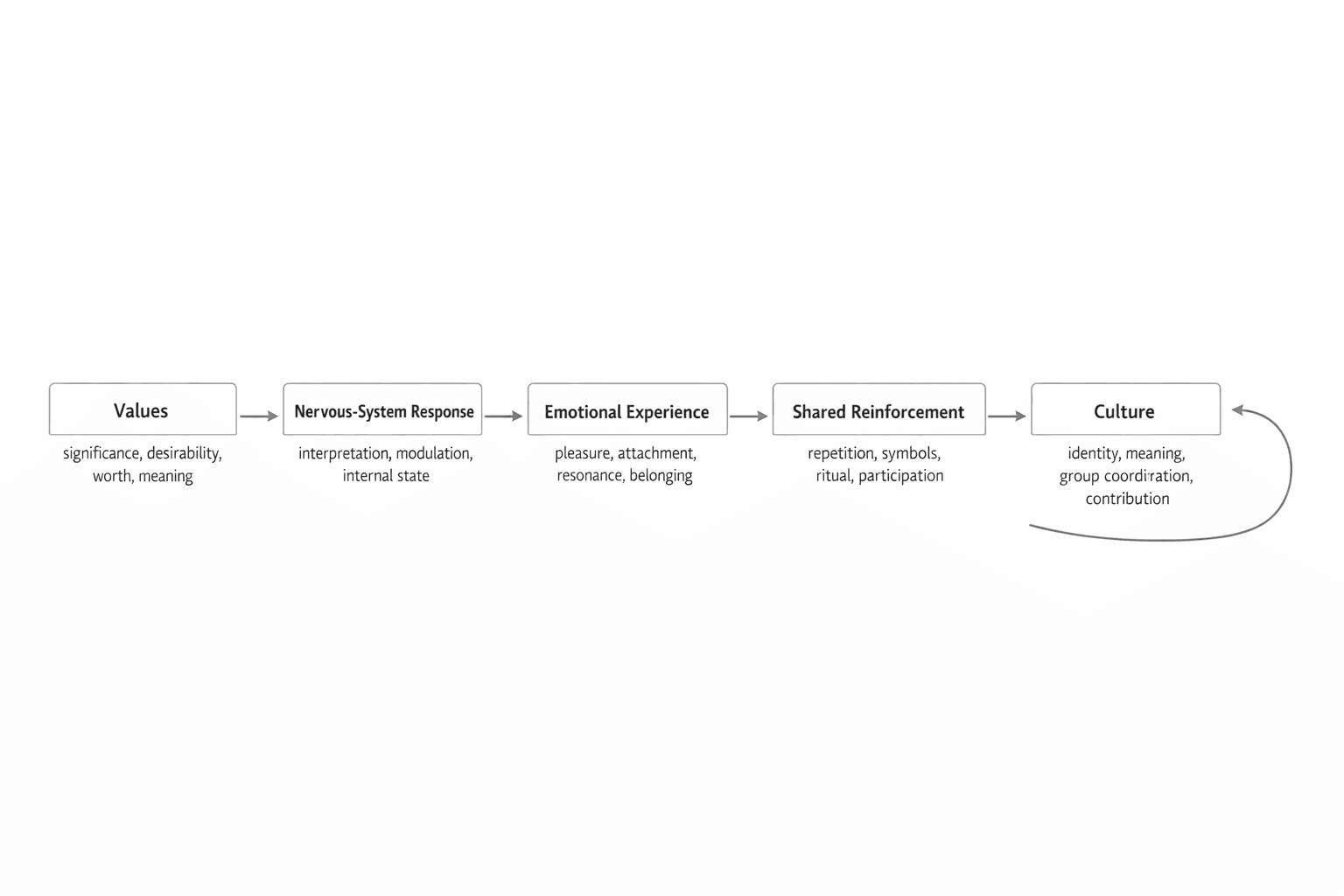
One of the paper’s strongest contributions is its process logic. Culture does not appear as a mysterious residue floating above human life. It forms through a chain: values organize significance, experience activates emotional response, repeated social reinforcement stabilizes shared meaning, and those patterns accumulate into culture.
That framing matters because it makes culture legible enough to design around without pretending that culture can be reduced to something simplistic. The point is not to flatten human life into a metric. The point is to recognize that the emergence of cultural force has a structure, and that structure can support system design.
This is where Human-Centered Systems begins to move from philosophy into engineering. If values, emotion, symbolic experience, and participation can be modeled as connected layers, then culture can become deliverable and administrable rather than merely observed after the fact.
The culture economy
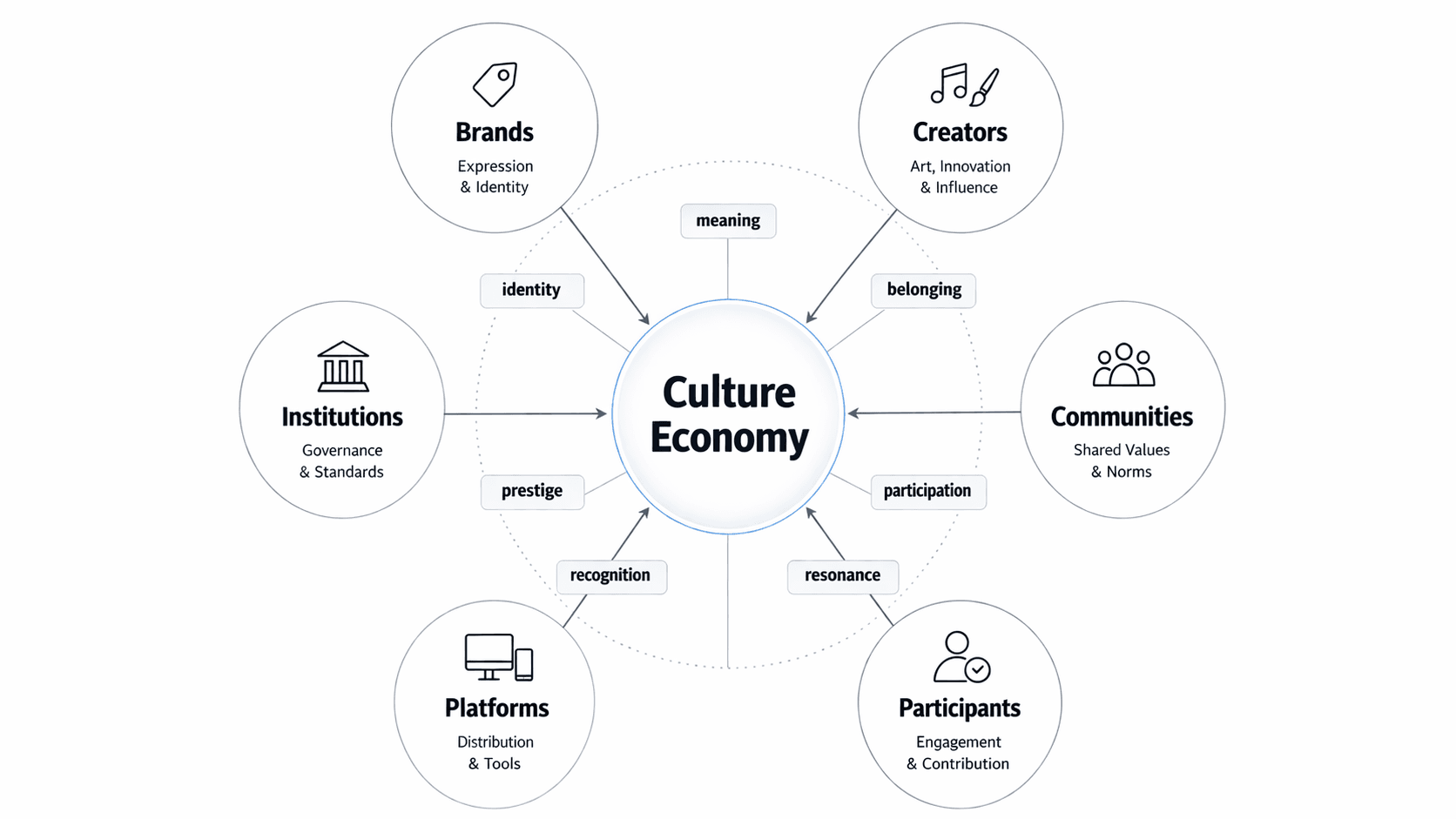
The paper uses the phrase culture economy to describe the domain in which value is created through identity, belonging, prestige, symbolic participation, and collective recognition rather than through function alone. This is not a metaphorical extension of existing markets. It is a claim about where durable value is increasingly won or lost.
Brands, artists, communities, movements, and platforms all compete in this arena already. They compete not only for awareness, but for relevance within the systems people use to understand themselves and one another. Human-Centered Systems proposes infrastructure for participating in that domain intentionally, rather than benefitting from it accidentally.
Why abundance changes the basis of value
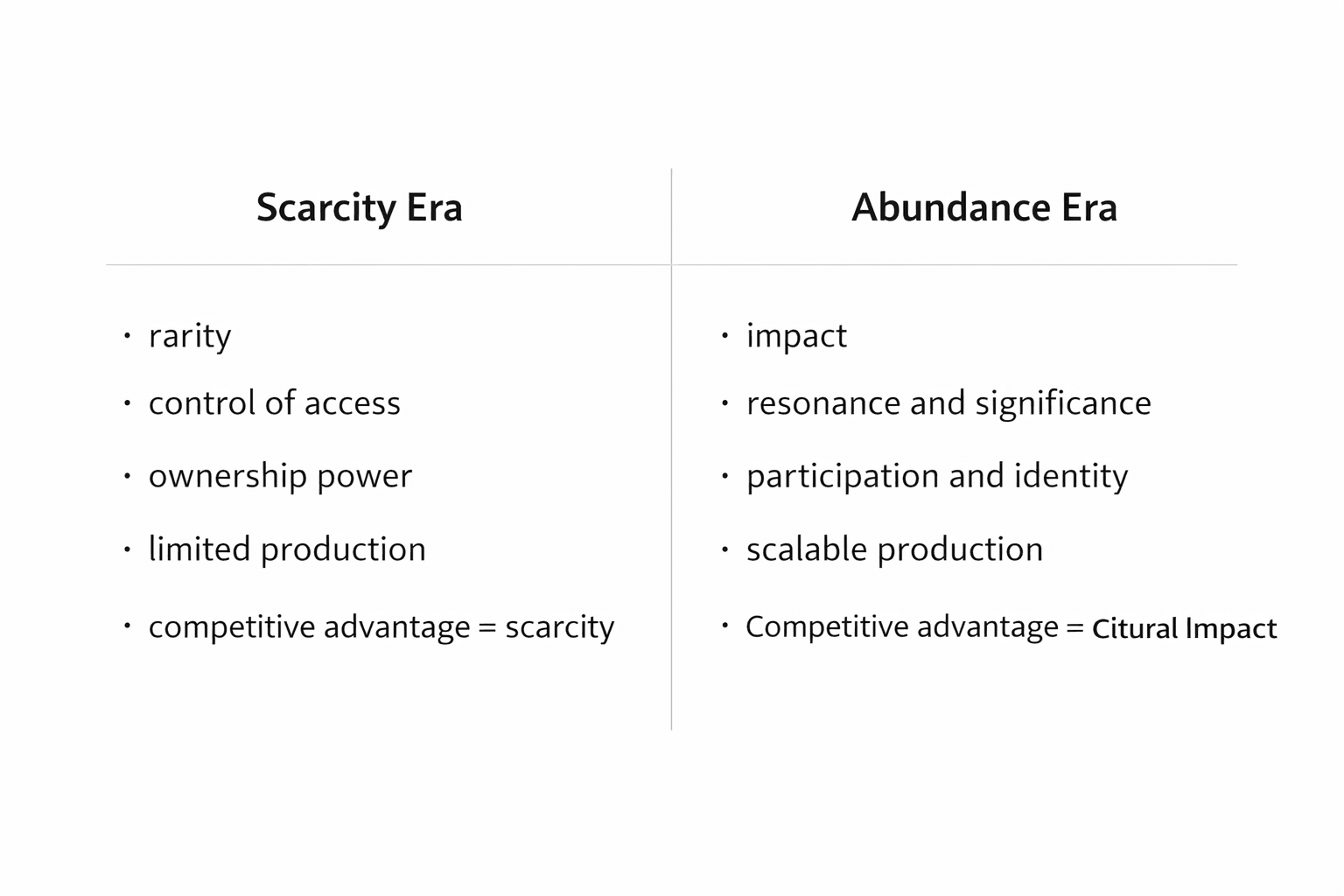
A major argument in the paper is that scarcity is no longer enough to explain competitive advantage. When production, distribution, and replication become easier, value shifts away from control alone and toward significance. In that environment, the decisive question is not simply who can restrict access, but who can generate resonance.
This leads to the paper’s concept of Cultural Impact: the degree to which an offering alters, reinforces, or deepens sensation, identity, belonging, meaning, and contribution within a culture. Cultural Impact becomes a way to explain why some offerings enter collective life while others remain merely available.
The HCS stack as infrastructure
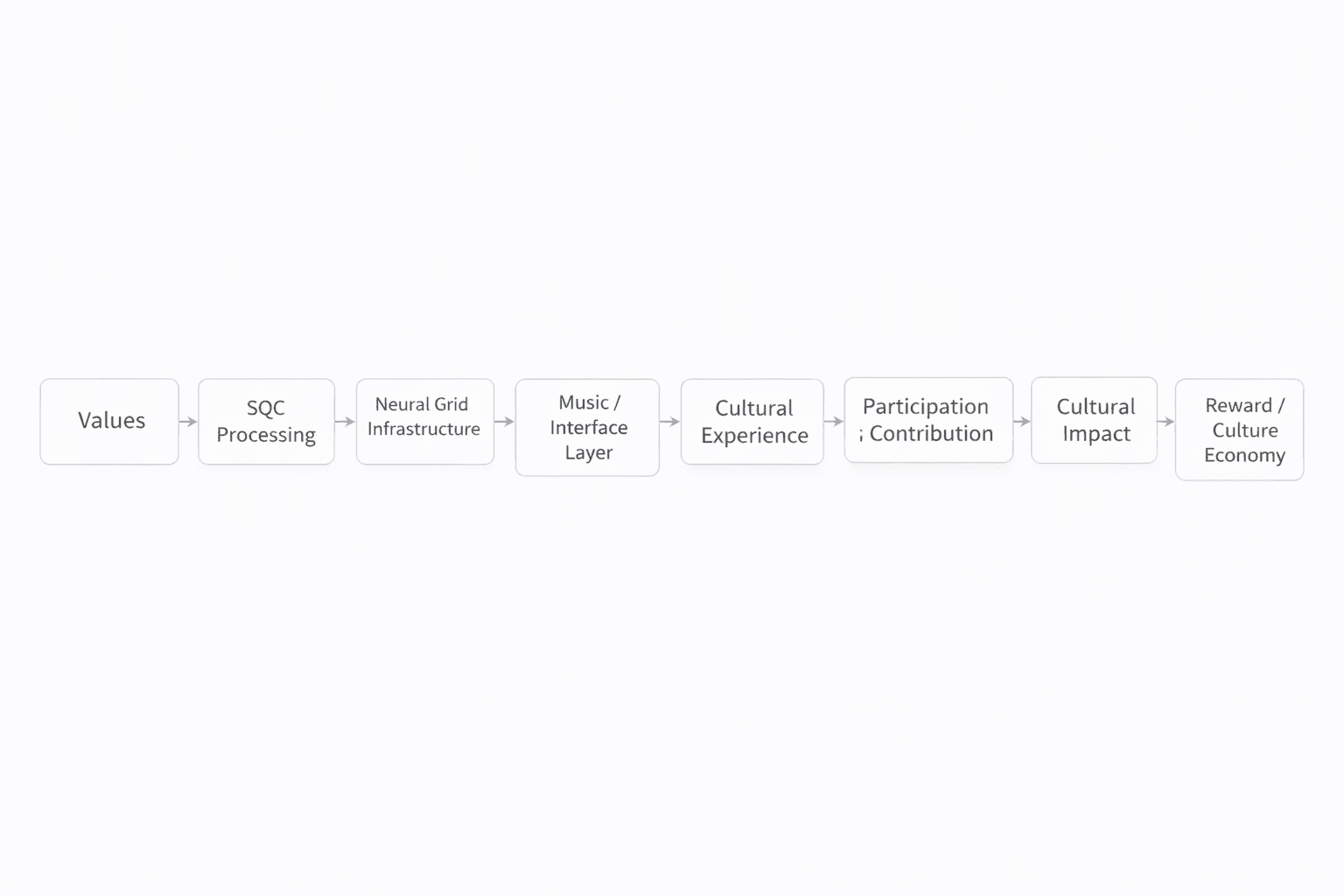
The white paper does not stop at diagnosis. It proposes a full stack. Sensia Quotia Computation is framed as the enabling neurocomputational engine for modeling how context, values, emotional modulation, and meaning shape human significance. The Neural Grid is then introduced as the infrastructure through which cultural sensation can be generated, coordinated, distributed, and activated economically.
Music 2.0 appears in the paper as the first applied ecosystem built on top of that stack, with music no longer treated as the final product but as an interface into culture itself. That move is strategically important. It shows how legacy sectors can become access points into a larger human-centered economy.
The broader institutional claim is that CVEST is not just building a product inside an existing category. It is positioning itself as the architect and administrator of a new category: one where culture becomes a managed layer of production, participation, reward, and market coordination.
Participation, governance, and the article’s real test
The paper is strongest when it refuses to treat participation as a passive downstream activity. If culture is the primary asset, then participants are not just consumers. They are contributors who help stabilize, circulate, and legitimize the very thing that generates value.
That logic naturally leads to questions of visibility, reward, and governance. A system that engineers culture without ethical bounds would drift quickly toward manipulation, extractive incentive loops, and representational distortion. The white paper acknowledges this directly and treats governance not as a compliance layer, but as part of the architecture itself.
That is the right standard. If Human-Centered Systems is to be more than a provocative thesis, it will need to demonstrate not only that culture can be made legible and economically active, but that such systems can remain fair, accountable, and socially constructive at scale.
Conclusion
The paper’s deepest proposition is simple: culture is already one of the strongest coordination systems in human life, and economies have under-structured it. Human-Centered Systems proposes that the next market frontier will not be defined only by better products, more access, or more efficient distribution, but by infrastructures that can intentionally shape meaning, belonging, and contribution.
Whether one agrees with every part of the architecture or not, the paper succeeds at naming a real shift. It offers a serious framework for thinking about culture not as decorative surplus, but as a primary layer of value creation.